A. M. A. Ayrookuzhiel: 30th Death Anniversary Bulletins
The “Bulletins” page documents the planning, progress, and activities related to the 30th death anniversary commemoration of A. M. A. Ayrookuzhiel, covering the period from April to November 2026.
Contents
- Bulletin 1
- Bulletin 2
- Bulletin 3
- Bulletin 4
- Bulletin 5
- Bulletin 5.1 — Preparatory Bulletin
- Bulletin 6
Bulletin 1
🗓️ Date: Wednesday, 15 April 2026
On Monday, 6 April 2026, between 8–9 am IST, a call took place between Sunil Abraham and Tito Dutta. During the call, Sunil shared his vision and ideas for the 30th death anniversary commemoration.
Following discussions with his brothers and other family members, Sunil outlined three objectives for the upcoming commemoration:
-
Essays not in Collected Works: A significant number of A. M. A. Ayrookuzhiel’s writings have been published in the collected volume Essays on Dalits, Religion and Liberation (2006). However, additional essays, papers, and lectures remain outside this collection. Work has already begun on identifying and documenting some of these on The Sunil Abraham Project. In the coming months, efforts will continue to locate further materials that are either unpublished or not included in the collected works. These may be compiled, documented, and, depending on progress, published as an ebook with an ISBN. A limited number of printed copies may also be considered.
-
Unpublished manuscript: At the time of his death in 1996, A. M. A. Ayrookuzhiel was working on a manuscript titled Dalit and Hindu Religious Identity, intended to examine the relationship between caste identity and faith traditions in India. Sunil expressed the intention to work towards completing this unfinished manuscript. This will require careful study, collection of materials, and preparatory work over the coming months. It has been suggested that the formal announcement of this effort may be made on Sunday, 29 November 2026, following sufficient groundwork.
-
Storytelling for everyone: Sunil proposed developing accessible storytelling formats, including slide decks, presentations, and other mediums, to communicate the core ideas of A. M. A. Ayrookuzhiel’s academic and literary work. The aim is to present these ideas in a way that is understandable and engaging for a wider audience, including those who may not be familiar with South Indian society, caste structures, or Dalit movements. Care will be taken to handle these themes with clarity and sensitivity while ensuring accessibility.
🧑🤝🧑 Event in Bengaluru: An in-person event will take place in Bengaluru, Karnataka on Sunday, 29 November 2026. The exact venue and schedule will be decided later. Planned activities may include a commemoration programme, presentations on A. M. A. Ayrookuzhiel’s life and works, and an exhibition.
Please add this date to your calendar and let us know if you are interested in attending. Further details will be shared in due course.
This concludes the first bulletin in this series. The second bulletin will be published on Friday, 15 May 2026.
Bulletin 2
🗓️ Date: Friday, 15 May 2026
Over the last one month, much of the work related to the 30th death anniversary commemoration of A. M. A. Ayrookuzhiel focused on content creation, documentation, and expanding the archival material available on The Sunil Abraham Project.
Navigational Template: A navigational page, Template:A. M. A. Ayrookuzhiel, was created during this period. The template brings together pages related to A. M. A. Ayrookuzhiel, including family members, books, essays, papers, and related articles, and is generally placed at the bottom of associated pages to improve navigation across the archive.
The Role of Religion in Dalit Liberation: Some Reflections: Published during this period was The Role of Religion in Dalit Liberation: Some Reflections, an essay by A. M. A. Ayrookuzhiel originally published in 1994 in The Role of the Philosopher Today, edited by Anand Amaladass, S.J. Structured around ten theses, the essay examines the relationship between religion, caste, social power, and liberation in the Indian context. A complete text version was also published as Full Text: The Role of Religion in Dalit Liberation: Some Reflections.
Christian Dalits in Revolt: Christian Dalits in Revolt was also added to the archive. First published in Jeevadhara, Vol. XXIII No. 136, July 1993, the essay examines the structural and ideological conditions shaping the experiences of Dalits within Christian communities in India. A full text version is available at Full Text: Christian Dalits in Revolt.
The Religious Factor in Dalit Liberation: Some Reflections: Work during this period also included The Religious Factor in Dalit Liberation: Some Reflections, first published in 1996 in Culture Religion and Society: Essays in Honour of Richard W. Taylor. The essay examines how religion, caste, and social power shaped both the oppression and political awakening of Dalits in India. A full text version is available at Full Text: The Religious Factor in Dalit Liberation: Some Reflections.
A Proposal for the Study of the Religious Heritage of the Dalits: An article was also prepared for A Proposal for the Study of the Religious Heritage of the Dalits: Some Methodological Considerations, first published in Religion and Society, Vol. 42, No. 1, March 1995. The essay explores Dalit religious traditions, shrines, myths, and ritual practices, particularly in Kerala, and their historical relationship with Brahmanical Hinduism. A full text version is available at Full Text: A Proposal for the Study of the Religious Heritage of the Dalits: Some Methodological Considerations.
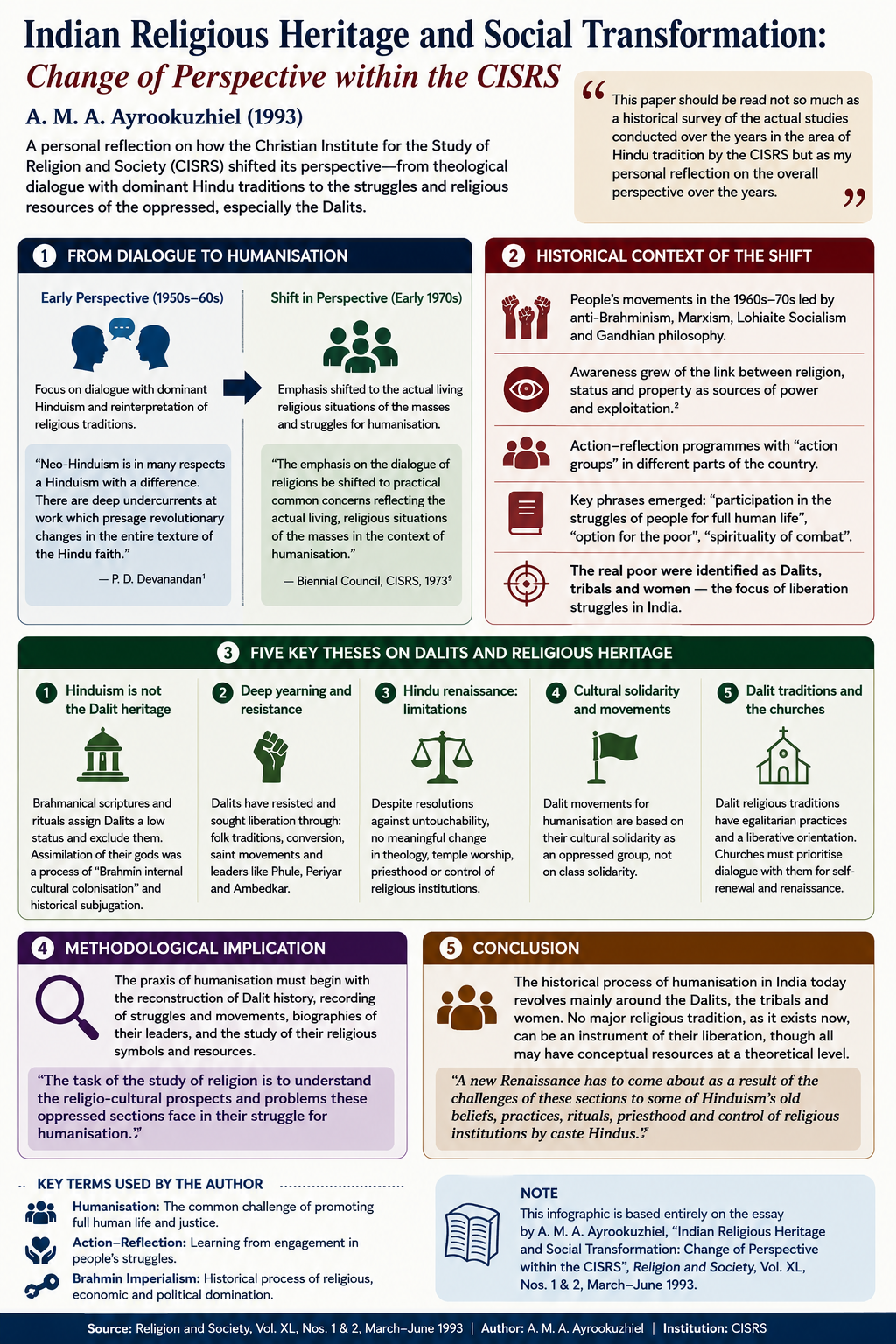
Indian Religious Heritage and Social Transformation: Indian Religious Heritage and Social Transformation: Change of Perspective within the CISRS was also documented during this period. First published in Religion and Society, Volume XL, Nos. 1 & 2, March–June 1993, the essay reflects on changing intellectual and theological approaches within the Christian Institute for the Study of Religion and Society (CISRS) towards Hindu traditions, Indian society, and social transformation. A full text version is available at Full Text: Indian Religious Heritage and Social Transformation: Change of Perspective within the CISRS.
Religious Legitimation and Delegitimations of Social Relations of Power (of Caste): Another essay documented during this period was Religious Legitimation and Delegitimations of Social Relations of Power (of Caste): The Case of the Dalits in Historical Perspective, first published in Religion and Society, Volume XL, No. 4, December 1993. The essay examines how caste oppression was historically sustained through religious legitimation, while also tracing counter-traditions that challenged this social order. A full text version is available at Full Text: Religious Legitimation and Delegitimations of Social Relations of Power (of Caste): The Case of the Dalits in Historical Perspective.
Chinnapulayan: A full text page was also created for Chinnapulayan: The Dalit Teacher of Sankaracharya, making the complete essay available online as part of the ongoing archival work related to the writings of A. M. A. Ayrookuzhiel.
Works Citing A. M. A. Ayrookuzhiel: One of the more ambitious archival efforts initiated during this period was Works Citing A. M. A. Ayrookuzhiel, a growing bibliographic collection of books, journal articles, theses, reports, and other publications that cite the works of A. M. A. Ayrookuzhiel. The references documented so far range from brief footnote and bibliography mentions to substantial academic engagement with his writings. Although the project is still at an early stage, five citations have already been identified and documented, with the expectation that the collection will continue to expand over time.
Bangla Article: Work also began during this period on দলিত মুক্তি আন্দোলনে ধর্মীয় প্রভাব: কিছু ভাবনা, a Bangla article based on The Religious Factor in Dalit Liberation: Some Reflections. The effort forms part of a broader attempt to make the writings and ideas of A. M. A. Ayrookuzhiel accessible to a wider readership beyond English-language audiences.
Bulletin 3
🗓️ Date: Monday, 15 June 2026
During the past month, work on the 30th death anniversary commemoration of A. M. A. Ayrookuzhiel continued through the documentation and publication of his essays and other scholarly works. A significant portion of the effort focused on expanding coverage of writings included in Essays on Dalits, Religion and Liberation (2006), while also bringing additional materials into the archive. During this period, work was completed on several essays that were not included in the collected volume.
Authority Control: A new page, Authority Control: A. M. A. Ayrookuzhiel, was created to bring together bibliographic identifiers, scholarly profiles, library catalogues, and archival references associated with A. M. A. Ayrookuzhiel. The page is intended to serve as a central reference point for researchers seeking authoritative records and external databases relating to his work.
Essays on Dalits, Religion and Liberation: Two additional pages were added in connection with Essays on Dalits, Religion and Liberation, the 2006 collection of Ayrookuzhiel’s writings. These include the Foreword by Dr. Godwin Shiri and the Introduction by K. C. Abraham. Together, these texts provide valuable context for understanding the significance of the collection and its place within Dalit theological and social thought.
Religion and Culture in Dalits’ Struggle for Liberation: Religion and Culture in Dalits’ Struggle for Liberation was added to the archive during this period. Originally published in 1986, the essay examines the relationship between religion, culture, caste hierarchy, and Dalit resistance movements. Particular attention is given to questions of social power, cultural domination, and competing responses to caste oppression. A complete text version was also published as Full Text: Religion and Culture in Dalits’ Struggle for Liberation.
The Dalits, Religions and Inter-faith Dialogue: Another important essay documented during this period was The Dalits, Religions and Inter-faith Dialogue, first published in 1994. The essay explores the implications of Dalit struggles for inter-religious dialogue in India, arguing that conversations between faith traditions must take account of social realities such as caste and exclusion. A full text version is available at Full Text: Dalits, Religions and Inter-faith Dialogue.
Dalits’ Challenges to Religious Systems — A People Ignored by Church History: Work during this period also included Dalits’ Challenges to Religious Systems — A People Ignored by Church History, first published in 1989. The essay examines the emergence of Dalit movements, critiques dominant historical narratives, and reflects on the challenges these struggles pose to both religious institutions and conventional church histories. A complete text version was also published as Full Text: Dalits’ Challenges to Religious Systems — A People Ignored by Church History.
The Dalit Church’s Mission — A Dalit Response: The Dalit Church’s Mission — A Dalit Response was also added to the archive. Published in 1996, the essay reflects on the role of Christian churches in the struggle for Dalit liberation and discusses questions of mission, empowerment, dignity, and social transformation. A full text version is available at Full Text: The Dalit Church’s Mission — A Dalit Response.
Swami Anand Thirth: Two introductory texts connected with A. M. A. Ayrookuzhiel’s study of Swami Anand Thirth were documented during this period. These include the Preface by Fr. Sebastian Kappen and the Introduction written by Ayrookuzhiel himself. Together, they provide background on the anti-untouchability activist, the historical context of the study, and the author’s approach to documenting social reform movements in Kerala.
Religion, Spirituality and Aspirations of the People: Another essay added during this period was Religion, Spirituality and Aspirations of the People, originally published in 1978. The essay examines popular aspirations for freedom, equality, justice, and human dignity, and considers the role of religion and spirituality in responding to these aspirations. A complete text version was also published as Full Text: Religion, Spirituality and Aspirations of the People.
Essays on Dalits, Religion and Liberation Notebook: An Essays on Dalits, Religion and Liberation Notebook was created during this period using Google’s NotebookLM platform. The notebook brings together materials related to Essays on Dalits, Religion and Liberation and serves as an experimental space for exploring the volume’s themes, sources, and historical context through AI-assisted analysis and discussion. (Google sign-in required.)
The continued publication of essays, supporting texts, and reference materials is helping to build a more comprehensive and accessible archive of A. M. A. Ayrookuzhiel’s writings and intellectual legacy.
This concludes the third bulletin in this series. The fourth bulletin will be published on Wednesday, 15 July 2026.
Bulletin 4 — Halfway Bulletin
🗓️ Date: Wednesday, 15 July 2026
This fourth bulletin marks the halfway point in the series documenting preparations for the 30th death anniversary commemoration of A. M. A. Ayrookuzhiel. While this is the fourth of eight planned bulletins, it marks the end of the third month of the seven-month preparation period, as the first bulletin primarily served as an announcement.
Between 12 April and 15 July 2026, 50 of the 59 pages currently listed under Category:A. M. A. Ayrookuzhiel were created. This means that most of the content currently available in this category was created during the dedicated documentation initiative that began in early April as part of the preparations for the 30th death anniversary commemoration.
Pages created during the commemoration initiative
12 April–15 July 2026
Number of pages created during each bulletin reporting period. The opening period covers four days, from 12–15 April 2026; subsequent reporting periods run from the 16th of one month to the 15th of the next.
At this stage, progress against the three objectives outlined in the first bulletin is as follows:
- Essays not in the collected works — 🟡 Slightly behind schedule: Three essays and three book reviews not included in Essays on Dalits, Religion and Liberation have so far been published on The Sunil Abraham Project. We currently have access to another two or three essays and articles, while more than five additional essays and book reviews have been located but their full texts are not yet available to us. We are coordinating with the Christian Institute for the Study of Religion and Society (CISRS) and the United Theological College Library to explore the availability of these materials. Registration through isbn.gov.in has also been delayed, affecting preparations for the proposed ebook and ISBN.
- Unpublished manuscript — 🟢 On track: Initial transcription, organisation, and mapping of the unfinished manuscript have begun. The surviving materials include the planned work Dalits and Hindu Religious Identity and nine accompanying essays, all of which were subsequently published in Essays on Dalits, Religion and Liberation and are also available on The Sunil Abraham Project. Further transcription and study should provide a clearer understanding of the structure of the unfinished work and its relationship with these essays. Based on this work, a more detailed assessment can be made before the proposed announcement in November.
- Storytelling for everyone — 🟢 On track: Work on the storytelling initiative has begun. The relatively limited production of storytelling materials during the first three months was intentional, as priority was given to content creation and expansion before developing infographics and other formats from the available material. With a larger body of content now available, regular production of infographics and other storytelling materials is planned between July and November. A broader strategy for sharing these materials, particularly through social media, has not yet been developed.
👁️ In particular, further attention is needed in four areas:
- organising, describing, and tagging the growing collection of photographs;
- completing registration with the Raja Rammohun Roy National Agency for ISBN;
- developing a social media and content-sharing strategy; and
- building stronger connections with relevant institutions.
This Month’s Update
Between 15 June and 15 July 2026, the following work was undertaken:
Unfinished Manuscript: Work began on the Unfinished Manuscript of A. M. A. Ayrookuzhiel (Working Document). The page brings together material connected with the manuscript that Ayrookuzhiel left incomplete at the time of his death in 1996, tentatively titled Dalit and Hindu Religious Identity. The working document is being used for the study, organisation, and possible reconstruction of the unfinished manuscript.
Dalits and Hindu Religious Identity: Proposed Contents: A separate page, Dalits and Hindu Religious Identity: Proposed Contents (Working Document), was prepared from a transcription of page 74 of the unfinished manuscript. The page appears to contain a proposed title and table of contents for the planned volume and provides information about the possible structure of the unfinished work.
Chapter 2, Methodology: Another part of the unfinished manuscript was documented as Chapter 2, Methodology (Working Document). The chapter discusses the methodology proposed for studying caste-specific religious life and Dalit participation in Hindu religious traditions.
The Dalit Deśiyata: Two pages connected with Ayrookuzhiel’s 1990 edited volume The Dalit Deśiyata: The Kerala Experience in Development and Class Struggle were added during this period. The Dalit Deśiyata: The Kerala Experience in Development and Class Struggle documents the volume and its focus on Dalit communities, development, class struggle, and politics in Kerala. A separate page, The Dalit Deśiyata: Introduction, presents the introduction to the volume and its discussion of development, class struggle, and Deśiyata in relation to Dalit liberation.
Swami Anand Thirth: Two further chapters from Ayrookuzhiel’s 1987 study of Swami Anand Thirth were documented during this period. Swami Anand Thirth: Sannyasa for the Sake of Outcastes covers the social and political background of early twentieth-century Kerala as well as the Swami’s childhood, education, and early influences. Attempts to Create a Counter-Culture examines educational, social, and cultural initiatives undertaken to challenge caste discrimination and develop an alternative social order.
The Church and the Study of Religion: The Church and the Study of Religion was added to the archive during this period. The article examines approaches to the study of religion from the perspective of poor and marginalised communities, with particular reference to the Hindu religious tradition.
Book Reviews: Three book reviews by A. M. A. Ayrookuzhiel, originally published in Religion and Society, were documented during this period. These are Approaches to the Study of Religion (Book Review), a review of the volume edited by Harbans Singh; Tamil Nadu: Deities and Devotees (Book Review), a review of the book by Gift Siromoney and K. R. Rajagopalan; and The Twice Alienated (Culture of Dalit Christians) (Book Review), a review of K. K. Wilson’s work on Dalit Christian culture.
Sacrafanations: Dalit Religion(s): Epistemology, Theology, and Politics: A page was added for Sacrafanations: Dalit Religion(s): Epistemology, Theology, and Politics, a 2023 edited volume by Y. T. Vinayaraj, jointly published by the Christian Institute for the Study of Religion and Society (CISRS) and the Indian Society for Promoting Christian Knowledge (ISPCK). The volume discusses Dalit religion, theology, epistemology, and politics and includes engagement with the intellectual work of A. M. A. Ayrookuzhiel.
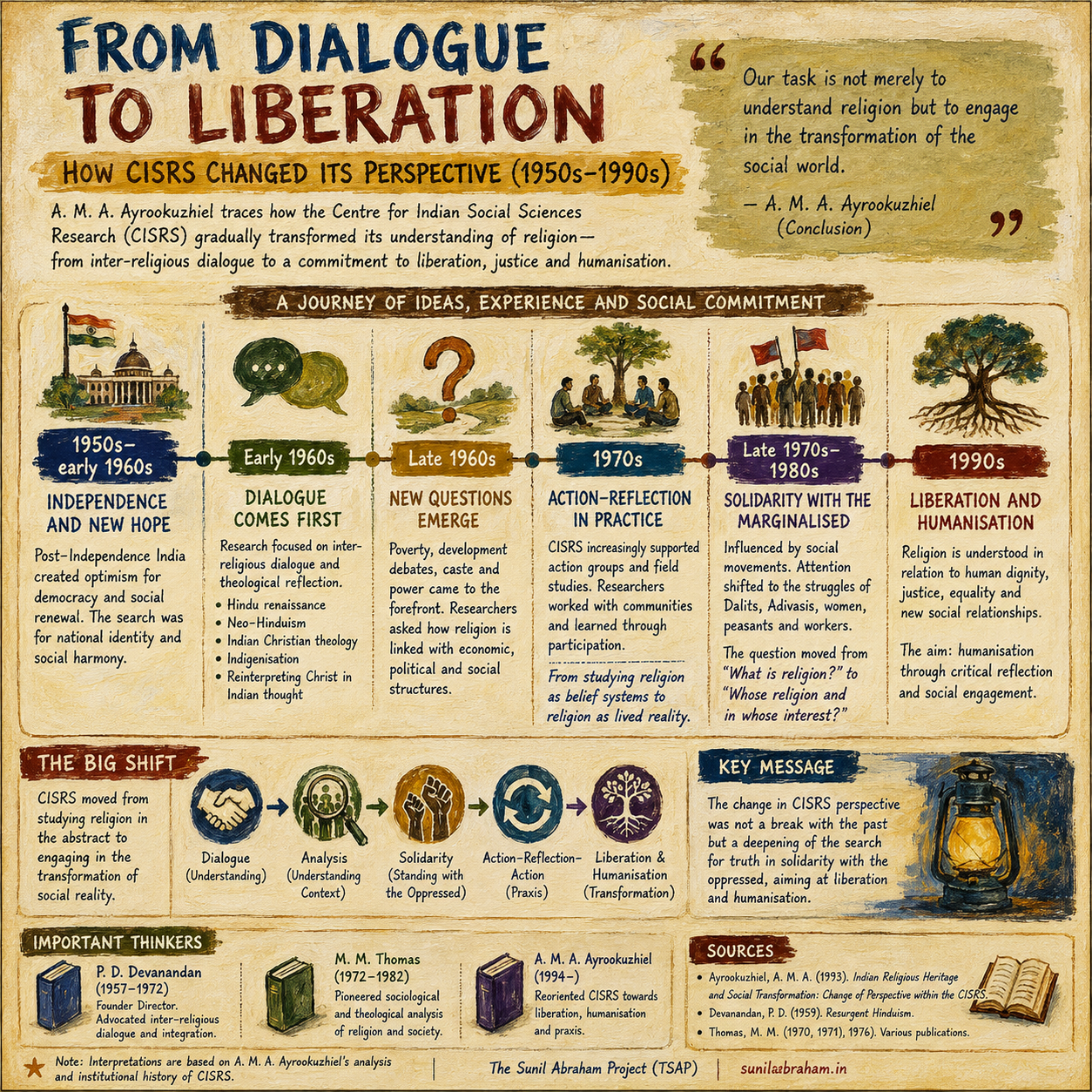
A. M. A. Ayrookuzhiel Storytelling Project: The A. M. A. Ayrookuzhiel Storytelling Project was documented during this period. The initiative is part of the preparations for the 30th death anniversary commemoration and explores ways of presenting A. M. A. Ayrookuzhiel’s life, writings, and ideas through accessible storytelling formats. The page outlines the objectives, editorial principles, workflow, and future plans for the project.
Bulletin 5
🗓️ Date: Saturday, 15 August 2026
This bulletin reports on the work undertaken and progress made towards the commemoration during the period from 15 July to 15 August 2026.
We began this month’s work by creating a page for Against the Sacred Abodes of Untouchability, the third chapter of the book Swami Anand Thirth. Beginning with the temple entry movement, the chapter follows Swami Anand Thirth’s efforts to challenge restrictions on worship, discriminatory practices that persisted after legal reforms, and the exclusion of Scheduled Castes from temple spaces and rituals.
We worked on My Journey on a Thorny Way: The Lord Upholding, the 2025 autobiography of Rev. Godwin Shiri. In an author’s note dated Christmas 2024, Shiri describes the book as a personal testimony and an expression of gratitude to God for sustaining and guiding him throughout his journey.
We worked on Religions and the Aspirations of the People, an article by A. M. A. Ayrookuzhiel published in Religion and Society, Vol. XXX, Nos. 3 & 4 (September–December 1983), pp. 102–108. The article examines the relationship between religion and social power, and considers the aspirations of poor, marginalised, and oppressed people.
We also worked on Dalit Liberation — Some Reflections on Their Ideological Predicament, an article by A. M. A. Ayrookuzhiel published in Religion and Society, Vol. XXXV, No. 2 (June 1988), pp. 47–52. The article examines the ideological tensions between Gandhian approaches to integrating Dalits within Hinduism and Dr. B. R. Ambedkar’s call for an independent struggle against caste and a challenge to Brahmanical authority.
We have published The Ideological Nature of the Emerging Dalit Consciousness, an article by A. M. A. Ayrookuzhiel published in Religion and Society, Vol. XXXVII, No. 3 (September 1990), pp. 14–23. The article examines the emergence of Dalit consciousness as an ideological and political response to caste oppression.
Royson’s visit to CISRS and UTC
This month, V. Royson, a TSAP member, visited the Christian Institute for the Study of Religion and Society (CISRS) and the United Theological College (UTC). He co-ordinated with the authorities at both institutions and scanned several materials. This made previously inaccessible materials available to the project.
Book reviews
Using materials made available by the institutions, particularly CISRS, and scanned by Royson, we worked on the following book reviews this month:
- Sadhus of India (Book Review), a review by A. M. A. Ayrookuzhiel of Sadhus of India by B. D. Tripathi, published by Popular Prakashan, Bombay, in 1978. The review appeared in Religion and Society, Vol. XXV, No. 4 (1978), pp. 88–89.
- Conversion and Social Equality in India (Book Review), a review by A. M. A. Ayrookuzhiel of Conversion and Social Equality in India: The London Missionary Society in South Travancore in the 19th Century by Dick Kooiman, published by Manohar Publications, New Delhi, in 1989. The review appeared in Religion and Society, Vol. XXXVII, No. 3 (September 1990), pp. 72–73.
- Conversion, Competition and Conflict (Book Review), a review by A. M. A. Ayrookuzhiel of Conversion, Competition and Conflict: Essays on the Role of Religion in Asia, edited by Dick Kooiman, Otto van der Muijzenberg, and Peter van der Veer, and published by Free University Press, Amsterdam, in 1984. The review appeared in Religion and Society, Vol. 32, No. 1 (1985), p. 85.
- Men and Gods in a Changing World (Book Review), a review by A. M. A. Ayrookuzhiel of Men and Gods in a Changing World by Judith M. Brown, published by SCM Press Ltd., London, in 1980. The review appeared in Religion and Society, Vol. 28, No. 1 (1981), pp. 78–79.
Writings not in Essays on Dalits, Religion and Liberation: We have now created a separate category to list and track works by A. M. A. Ayrookuzhiel that were not included in Essays on Dalits, Religion and Liberation (2006). The category serves as a tracking tool for the 30th death anniversary commemoration of A. M. A. Ayrookuzhiel on 29 November 2026, as the project works towards locating and documenting these writings. As of 15 August 2026, seven essay pages have been added to this category.
Raja Rammohun Roy National Agency for ISBN Registration
This month, we completed our registration with the Raja Rammohun Roy National Agency for ISBN. The registration had been delayed on our side.
The portal requires applicants to first create an account using an email address and password. During sign-up, applicants must select one of the available categories: Publisher, with the subcategories “Institutional” and “Commercial”, or Author, with the subcategories “Author” and “Individual Author/IndividualPublisher other than author”.
According to the portal:
Institutional Publishers are those who publish books under some statutory authority and accordingly they do not have a PAN or Udyog Aadhaar Number Example: Publication Division of Government of India / Central/ States School board / NCERT /NBT/ Publications by Universities. Some proof of Identity of the Administrator will be required later in this application.
The portal further states:
Commercial Publishers are those who sell their books under their brand name and they have their PAN or Udyog Aadhaar Number in the some of Publishing Agency or PAN in the name of the Administrator of Publishing Agency.
We did not appear to be eligible for the Institutional Publisher category, while we also wanted to register as a project rather than under the Author category. We therefore initially signed up under the Commercial Publisher category.
However, when we continued with the registration, we found that completing the application required documents such as company incorporation documents, GST registration, Udyam registration, or another government document carrying the name of the company. We did not have these documents.
As part of the same registration process, we therefore changed the category to Individual Author/IndividualPublisher other than author. We initially entered the imprint name as “The Sunil Abraham Publishers”. The application was rejected a few days later with the following email:
Dear The Sunil Abraham Project,
This is to inform you that your ISBN account registration has been rejected due to the following reason/s.
Name of administrator does not match with the documents..
You may please login with the provided ID and password and re-register with correct details/documents.
We understood the reason for the rejection: the documents we had submitted were Tito Dutta’s Aadhaar and PAN, and neither document carried the name “The Sunil Abraham Project”.
We edited the application, changed the imprint name to “Tito Dutta”, and resubmitted it. This time, we received the following response:
Dear Tito Dutta,
Your registration is completed and approved. Please Login to submit further details of application.
Our ISBN registration is therefore now complete under this arrangement. The next step will be to apply for an ISBN once the manuscript is complete. We will report further progress in the upcoming bulletins.
Unfinished Manuscript Works
We continued work on the Unfinished Manuscript of A. M. A. Ayrookuzhiel (Working Document) this month, including another remapping of the manuscript’s contents.
Following this remapping, we worked on two chapters of the manuscript:
- Dalit Shrines (Kurava, Pulaya & Paraya), which examines Dalit shrines among the Kurava, Pulaya, and Paraya communities in Kottarakara Taluk, Kollam District, including their origins, myths, ownership, objects of worship, offerings, and priesthood.
- Chapter 2, Devaswom Board Temples, which discusses Devaswom Board temples, their history and administration, the opening of temples to Dalits and other backward castes, Panchayat and Trust Temples, and the ritual jurisdiction of temple priests.
Bulletin 5.1 — Preparatory Bulletin
🗓️ Date: Tuesday, 1 September 2026
The regular bulletins of the 30th death anniversary commemoration are published on the 15th of each month. Bulletin 5.1 is a preparatory bulletin, being published at the beginning of September to mark an important transition in the work towards the commemoration.
From 1 September to 15 October 2026, a dedicated period of editing, contributing, and enhancement will take place. The first months of the project have involved substantial work in locating, documenting, transcribing, and publishing materials relating to the life and work of A. M. A. Ayrookuzhiel. This next phase provides an opportunity to review that work, strengthen what is already available, and invite further contributions.
The work during this period will continue to be guided by the objectives and areas of work established during the project:
-
Writings not in Collected Works: Continue to locate, document, edit, and make available essays, papers, lectures, book reviews, and other writings of A. M. A. Ayrookuzhiel that are not included in Essays on Dalits, Religion and Liberation.
-
Unpublished manuscript: Continue the study, transcription, organisation, and mapping of the surviving materials relating to Dalit and Hindu Religious Identity, with further work towards understanding the structure and scope of the unfinished manuscript.
-
Storytelling for everyone: Develop accessible ways of presenting and communicating Ayrookuzhiel’s ideas and work through presentations, infographics, visual material, and other storytelling formats for wider audiences.
-
General project improvements: Strengthen the wider portal and project through improvements to navigation, discoverability, internal linking, metadata, accessibility, photographs and archival documentation, institutional connections, and other areas that can improve the quality and usefulness of the archive.
This dedicated period is intended not simply to add more material, but to improve, connect, review, and build upon the substantial body of work that has already been created.
The work and progress during this phase will be listed and tracked through the project’s GitHub Project and the 30th Death Anniversary label. This will provide a central place to document the work, track progress, and organise contributions during the phase.
The preparatory bulletin therefore marks the beginning of this focused phase. The regular monthly bulletin cycle will continue alongside this work, with Bulletin 6 scheduled for 15 September 2026 and Bulletin 7 for 15 October 2026. Bulletin 6 will report on the work undertaken during the preceding month, including the first 15 days of the dedicated phase, while Bulletin 7 will report on the work of the final month and mark the conclusion of the dedicated editing, contributing and enhancement phase.
Bulletin 6
🗓️ Date: Tuesday, 15 September 2026
This sixth bulletin reports on the work undertaken and progress made towards the commemoration during the period from 15 August to 15 September 2026.
We continued our work on the unfinished manuscript of A. M. A. Ayrookuzhiel by documenting the 22 August 2026 Meeting: Methodology and Vision for the Unfinished Manuscript. The meeting, held on Google Meet as part of the preparations for the 30th death anniversary commemoration, helped clarify the distinction between the surviving 115-page source document and the unfinished manuscript itself. The proposed approach involves studying the surviving fragments alongside Ayrookuzhiel’s wider body of writings and collecting contemporary material through detailed research in Kottarakkara Taluk, including documentation of places of worship, objects, forms of worship, religious functionaries, festivals, photographs, audio, video, maps, and geographical information. The meeting also discussed a possible research team of 10 researchers working for at least 10 months, followed by further development, review, and discussion of the reconstructed manuscript. The ideas recorded on the page are proposals from the meeting and not a finalised methodology.
We worked on Dalit Kavithakal: Oru Padanam, a Malayalam-language book by Paul Chirakkarodu, M. Sathyaprakasham and Athanasius Mathen Abraham Ayrookuzhiel, published by the Christian Literature Society in Tiruvalla in 1992. The book, whose title translates as Dalit Poems: A Study, is cited in scholarly literature on Dalit theology, caste, religion and identity, including a University of Glasgow doctoral thesis. It has also been included in university-level Malayalam literature syllabi, providing independent references for its bibliographic details and place within the study of Dalit literature in Kerala.
We also worked on Dalit Sahityam, a Malayalam-language book by Paul Chirakkarod and Athanasius Mathen Abraham Ayrookuzhiel, published in Tiruvalla in 1995. The work followed their earlier Dalit Kavithakal: Oru Padanam and is cited in a University of Glasgow doctoral thesis under the title Dalit Sahityam: Oru Padanam. The available scholarly reference discusses the book in connection with Dalit experience, social oppression, literary works, and the representation of Dalit experience. Further documentation will be added as the original volume and additional reliable sources become available.
We have published Religion, Culture and Power (Editorial), an editorial by A. M. Abraham Ayrookuzhiel published in Religion and Society, Vol. XXXII, No. 1, in March 1985. The editorial introduces the issue’s examination of the relationship between religion, culture and power in South Asia, drawing attention not only to the visible political dimensions of religion but also to less visible power relationships within religio-cultural systems, including those involving gender and caste. The issue brought together studies on caste, religion and people’s movements in Kerala, community identity, village Hindu religion and the aspirations of oppressed communities, as well as a study of Kurukh Christian lyrics and questions of indigenous theological expression.
A. M. A. Ayrookuzhiel Knowledge Engine
One of the important areas of work during this period has been our exploration of an AI-powered search and research interface for the writings and archival material of A. M. A. Ayrookuzhiel.
We had been exploring different options for making the growing A. M. A. Ayrookuzhiel archive searchable through natural-language questions. We had previously experimented with Google’s NotebookLM, which provided a useful way of working with a collection of source material, but it did not provide the kind of public, embeddable search interface that we wanted to integrate directly into The Sunil Abraham Project website.
In August 2026, we found that Cloudflare had significantly expanded and made its AI Search service available for building search systems over a project’s own data. On 6 August, Cloudflare announced new AI Search capabilities including public endpoints, website crawling, custom domains and other features intended to make AI Search usable in applications and public-facing websites.
We therefore started experimenting with Cloudflare AI Search for the A. M. A. Ayrookuzhiel archive. The system uses Cloudflare AI Search in the backend to retrieve and generate answers from the indexed archive material, while we built a dedicated search interface for the project. The interface is hosted on GitHub Pages within The Sunil Abraham Project at A. M. A. Ayrookuzhiel — Knowledge Engine. The page is currently marked as a “Preparatory version” because the system is still being developed and evaluated.
The Knowledge Engine is intended to be more than a conventional keyword search. Visitors can ask questions in natural language and receive an answer based on the indexed archive, with sources and references presented where available. The implementation also includes safeguards for rendering AI-generated Markdown and links, together with responsive design, keyboard accessibility, reduced-motion support and light and dark mode support.
This work represents an early experiment in developing a dedicated AI research interface around a historical archive, while keeping the public-facing interface and the underlying archive within the infrastructure of The Sunil Abraham Project.
ISBN application
Following our ISBN registration process described in the fifth bulletin, we have now submitted an application for an ISBN for Essays on Dalits, Religion and Liberation II, by A. M. Abraham Ayrookuzhiel. The application has been submitted to the Raja Rammohun Roy National Agency for ISBN Registration under the imprint “The Sunil Abraham Project”. It has been assigned the application reference number 44138|ISBN|2026|A and is currently awaiting processing.
📄 This page was created on 12 April 2026. You can view its history on GitHub, preview the fileTip: Press Alt+Shift+G, or inspect the . Last updated on 2 September 2026.